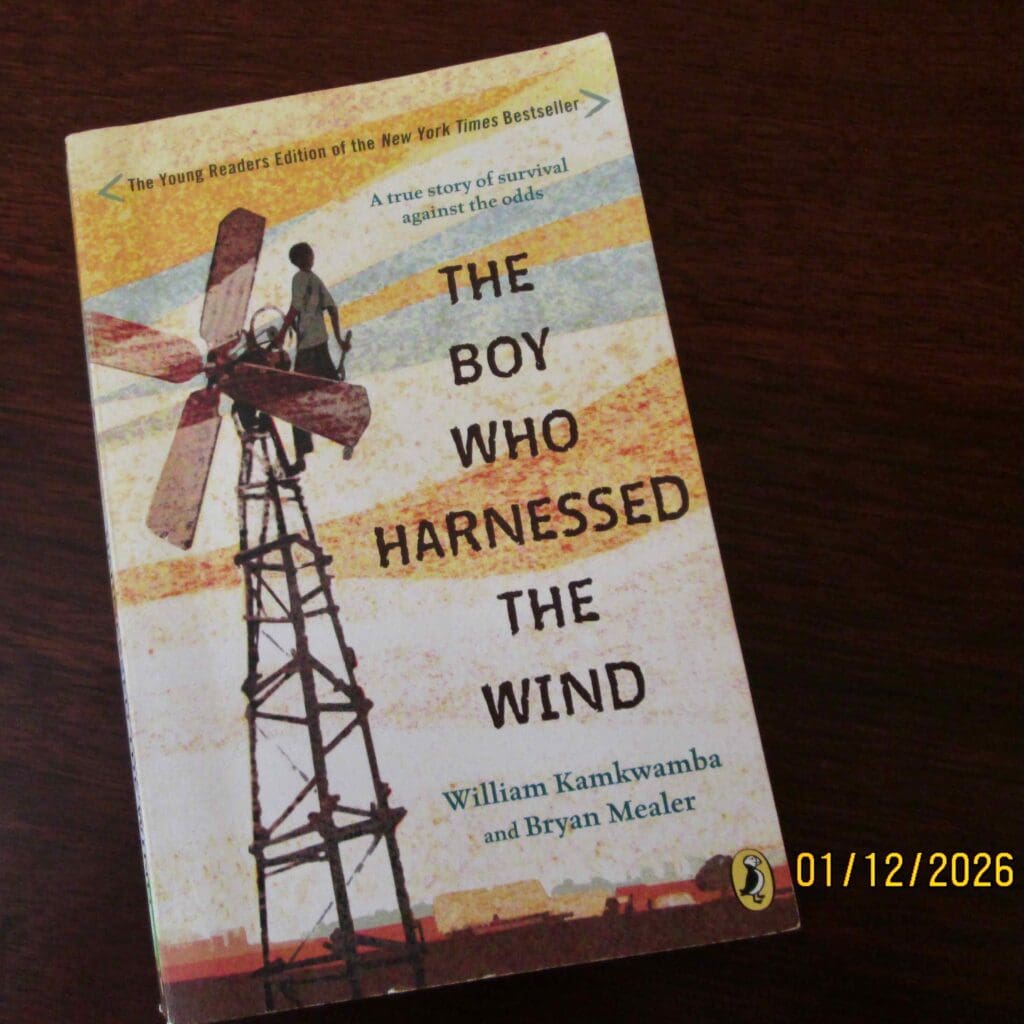
My son lent me a book that he said I would enjoy reading. It took me a while to get to it, and then I couldn’t put it down. This book, The Boy Who Harnessed The Wind, by William Kamkwamba and Bryan Mealer, is a middle grade true story about William, who lives in Malawi, Africa.
As a child, William grew up in a country with many superstitions, witchcraft, and medicine men. Early on, he was able to learn the trickery that goes along with these practices and moved on to being able discern what is real. At age thirteen, William developed a love for science. William, his cousin Geoffrey, and friend, Gilbert, entertained themselves with a radio. They had no TV or electricity, but the radio ran on batteries and they could listen to music, news, and sports.
William wanted to know how the radio worked so they began taking apart any radio they could get and examined the wires, transistors, and speakers.
These boys had to pass exams to be admitted into the middle grades and William was hoping to get into a school that focused on science. His grades were not good enough, and he didn’t get into the school he wanted. Then a drought destroyed their crops, the main one of corn, and all of Malawi begin to starve. William had to drop out of school because they could not pay his fees and for his uniforms.
His family begin to run out of food until they were down to one meal a day. The government would sell them food at very high prices, or lace the ground corn with sawdust to make it go farther—which caused sickness. On that one meal a day, they had to work the fields as new corn was growing.
He loved his dog, Khamba, but the dog was slowly starving to death as they all were, and there was no longer food to feed him. William couldn’t bear to see the dog pass away so he walked Khamba into the forest and tied him to a tree. He checked on him the next morning. As soon as William was no longer near the dog, to give him the will to live, the dog passed away during the night.
There is no poor and starving that I’ve ever seen or read about that compared to what William and his family went through until the next crop flourished, and they finally begin to be able to eat again. But the famine took it’s toll. There was no money for school. All the money had been used up trying to buy food to keep them alive. William, who wanted so badly to learn science had to drop out.
Where does hope come from when there is none?
Although William was starving, not only for food, but for an education, he would pick himself up out of his dire situation that would make most people give up, and keep pushing forward for what he wanted.
William discovered a very small library near the school and begin to check out books about science. He learned how electricity worked. He had no money, but using scrapes from a local junk yard with old motors, and wires, along with digging up PVC pipes out of the ruins of old houses, he begin to work on a windmill.
His first idea was to provide electricity to his home. His second idea was to be able to pump water in times of drought to prevent famine. Gilbert and Geoffrey remained faithful friends and sometimes provided parts that he needed.
The village people made fun of him for spending all his time in the junk yard digging for parts and said he was crazy. But a hope stirred within him that most of us could never understand.
There is way to much of the story to share more here, but I hope you will read his biography. He is 39 years old today, and a graduate of Dartmouth College in New Hampshire.
Now the most interesting part of the story for me is this—
At our church Sunday morning, there was a visiting missionary that does work in Malawi providing clean water. We are new to our church and had no idea that our church had supported the building of several houses for the people of Malawi.
Since we’re new, normally we go to first service and leave out the side door, but reading about William made me want to talk with the missionary and get a card on how to support their work.
We are also having sign ups for life groups for the spring semester so these tables were scattered near where I was standing, and the life group leaders were at these tables.
I was talking to the missionary when a friend that I went to church with twenty years ago, and had a Bible study group with, appeared beside me. Because our church has three services, we had not run into each other, and although I have followed her on facebook, I had no clue that she went there. She had noticed me when I walked past her table. She is a life group leader for a women’s group at the church. It was a joyful reunion.
Before church, I had been praying about my word for this year “HOPE” and asking God all morning, how do I recognize hope. I think I received a very strong answer, not long after praying.
I have never read of a situation so dire as William was in, and yet he studied science books and educated himself to build a windmill that would provide electricity and water for his family and their village. Even when the villagers were making fun of him (Think of the story of Noah. Think of Jesus.)
And, he was essentially dying from starvation.
Yet, William found the strength to press on.
Pray for hope to fill your life as you press on toward your calling. And then start looking for the hope that shows up all around you, in people and places.
I pray you have a great week!
Thank you for the review. Sounds like an encouraging book.
Such an important reminder about the importance of hope, now more than ever we need more of it!
You are so right, Ariana. Hope is good!