
Today, Monday, December 22nd, starts the beginning of the countdown to Christmas Day. There is excitement in the air, especially for children.
As parents and grandparents, we point them over and over to the meaning of Christmas, but there is just something about dreaming of big gifts you’ve wanted all year long that tends to override Jesus’ birth and how important that is to all of us.
And that’s okay. The Lord will speak to them through the years, as they are reminded over and over each year and as their relationship with Jesus develops. Jesus will make His way to the top of their list of Christmas excitement in the years to come.
If you are trying to find ways to keep your kids busy while out of school, I would like to suggest looking at the Children’s Classics to give them something to read during periods of quiet time.
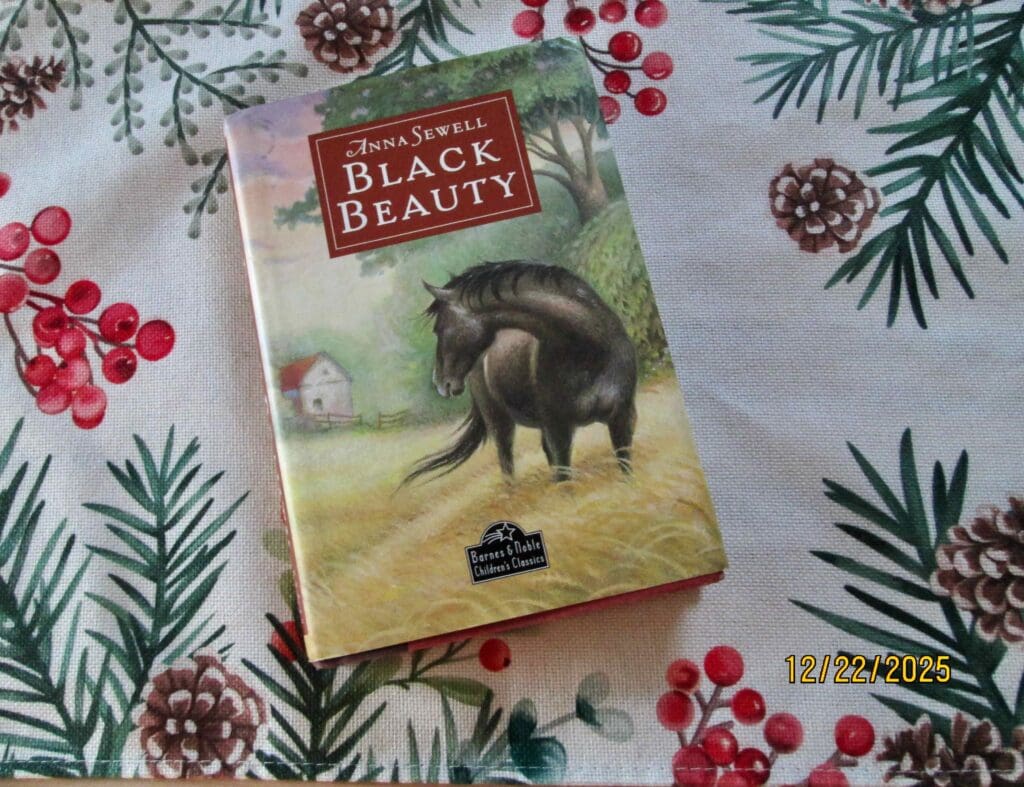
My oldest Grandson gave me his copy of Black Beauty, by Anna Sewell, about three weeks ago. I was supposed to read it in a week, but that didn’t happen. To honor his request, I’ve started reading it this past week, and I am so impressed with the themes about good character, evil people and what happens to them, and the scriptures that are gently intertwined into the story.
If you haven’t read, Black Beauty, or it’s been a long time—it is worth picking up again. First published in 1877, the story is told from the viewpoint of the horse. This is the only book that Anna Sewell published, but it was a huge success.
My favorite chapter so far is thirteen and titled “The Devil’s Trademark.” It begins on a day when, John, Black Beauty’s caretaker, was traveling back to Squire Gordon’s home riding Black Beauty. They see a boy whipping a pony to make him jump a fence that was too high to jump. The pony refused, and the boy got off and begin to hit him on the head and “thrash” the pony. (p. 56)
The boy got back on the pony after the beating, and the pony bucked gently and threw him off into a hedge with thorns. The boy saw John and cried out to him for help.
“‘Thank ye,’ said John, ‘I think you are quite in the right place, and maybe a little scratching will teach you not to leap a pony over a gate that is too high for him.'” (p. 56)
As John rode away he decided to go by the boy’s father’s farm and let him know what had happened because as John spoke his thoughts out loud he said, “‘It may be,’ said he to himself, ‘that young fellow is a liar as well as a cruel one. We’ll just go home by Farmer Bushby’s, Beauty, and then if anybody wants to know, you and I can tell ’em, ye see.'” (p. 57)
The mother of the bully was upset and worried to find her son was left in a thorn hedge. The father understood the situation and advised her, “‘You had better go into the house, wife,’ said the farmer. ‘Bill wants a lesson about this, and I must see that he gets it. This is not the first time, nor the second, that he has ill-used that pony, and I shall stop it.'” (pp. 57-58)
What an example of great parenting!
When John got home he told James (a boy in his late teens who also worked with the horses) what happened. James had his own story to tell of the boy’s cruelty. At school that same boy had been bullying the smaller boys, and one day James had found him catching flies and pulling off their wings. James, “boxed him on the ears” and the boy “roared and bellowed” so loudly the school master rushed in to see if someone was being murdered. The school master found the flies on the window ledge, “some crushed and some crawling about helpless.” The boy carried on so much that the school master only made him sit on a stool for time out.(p. 58)
But the school master did impart wisdom to the rest of the boys. He “talked to all the boys very seriously about cruelty, and said how hard-hearted and cowardly it was to hurt the weak and the helpless.” But what stuck in James’ mind was when “he said that cruelty was the devil’s own trademark, and if we saw anyone who took pleasure in cruelty, we might know who he belonged to, for the devil was a murderer from the beginning, and a tormentor to the end. On the other hand, where we saw people who loved their neighbors, and were kind to man and beast, we might know that was God’s mark, for ‘God is Love.'”(pp. 58-59)
Children love to read stories of when other’s mess up and when others are good. It helps to set them on a path of knowing what not to do. I love that this part ends with the school master telling them “God is Love.” And even through those words— the Christmas story is conveyed.
I pray you have a very Merry Christmas and have some time to read a few Classics over the holidays!

Merry Christmas, Jane!
Thanks, Tim. Merry Christmas and Happy New year!
Thanks for sharing your thoughts about the book, Jane.
You’re welcome, Joni.